
A new artist residency by Space52 × Kalogerou
Othoni Island, Greece | July 2026
The program is hosted at Kalogerou 1844. Space52, in collaboration with Kalogerou, presents IONIAN LAB, a new artist residency program launching in July 2026 on the remote border island of Othoni, the westernmost point of Greece.
IONIAN LAB was born from the shared desire of the two organizations to create a platform for research, production, and the exchange of ideas, where contemporary artistic practice meets a place with a strong historical, natural, and cultural identity. The program’s goal is to foster artistic creation through the lived experience of the place, promoting new forms of dialogue between the artists, the landscape, and the local community.
Space52, founded in Athens in 2017 by visual artist Dionisis Christofilogiannis, is an independent contemporary art space with strong international activity. Through exhibitions, residencies, publications, and collaborations with organizations in Greece and abroad, it supports the production of new work and the development of dialogue around contemporary visual practice.
The inaugural edition of IONIAN LAB hosts four artists with different artistic backgrounds and means of expression:
Dimitris Kontodimos, sculptor and installation artist, who investigates urban experience, materiality, and social structures through works that activate collective memory.
Dionisis Christofilogiannis, visual artist, whose work explores the relationships between memory, history, architecture, and collective identity through installations, sculpture, and photography.
The Krank, visual artist whose work moves between painting, new media, and installation, exploring the relationship between technology, image, and contemporary culture.
Vasiliki Koukou, painter, whose practice combines abstraction with elements of mythology, dream, and surrealism, creating poetic and symbolic visual environments.
During their stay in Othonoi, the artists will conduct on-site research, walks, meetings, and artistic activities, developing new works inspired by the island’s geography, history, myths, architecture, natural environment, and human narratives. Isolation, the maritime border, population movements, collective memory, and the relationship between people and landscape are key axes of the artistic research.
IONIAN LAB treats the island not as a neutral host site, but as an active participant in the artistic process. The production of the works emerges through direct experience of the place and the encounter of different artistic approaches, creating an open space for the exchange of knowledge, collaboration, and experimentation.
With the founding of IONIAN LAB, Space52 and Kalogerou launch a long-term collaboration aimed at establishing the Diapontia Islands as a site of contemporary artistic production and international cultural dialogue — connecting the periphery to contemporary art networks and creating new possibilities for research, creation, and cultural exchange.
Dimitris Kontodimos
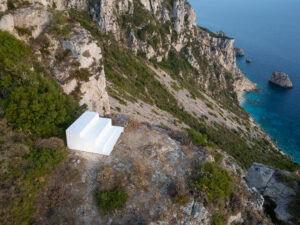
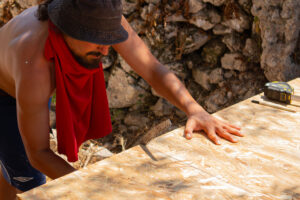 Othonoi was once known as Othronos (from the Greek “ο Θρόνος”, meaning “the Throne”). In this work, a four-step platform is installed not as the seat of an individual, but as a collective site of presence on the island’s western edge. Facing west, the work turns towards a horizon that carries both a geographical and symbolic significance.
The Greek word for “West”, δύση, derives from the ancient verb δύω, meaning “to sink” or “to submerge”, originally referring to the setting of the sun. From this, δύση came to signify the west, the point where the sun disappears into the horizon. This connection also gives the word a metaphorical sense of ending, as the sun sets and darkness follows. Direction and conclusion converge in the same word. The work inhabits this overlap. To face west from here is to encounter the end of the land, the edge of the landscape, and the limits of a particular idea of belonging.
For generations, the west has been imagined as a direction of salvation. Leave the east, arrive somewhere better. Cross the sea, find security, prosperity, and political freedom. For those standing at a border facing the right horizon, west has often been less a compass point than a promise.
The sculpture West/End (For those who made it this far) watches the horizon not only as a geographical threshold but as an ideological one. From here, “the West” is not simply a direction but a political imaginary, a destination that has shaped movements of people, justified borders, and sustained unequal geographies of hope. Rather than celebrating that horizon, the work lingers with it, asking what it means to face, inhabit, and guard a promise that has never been equally available to everyone.
In 1968, Jim Morrison lifted two lines from the table of contents of James George Frazer’s The Golden Bough. The lines came from Chapter LX, titled “Between Heaven and Earth”: subchapter 1, Not to Touch the Earth; subchapter 2, Not to See the Sun. In Frazer’s original context, these were ancient taboos imposed upon kings, priests, and the sacred, figures whose power was so absolute, so volatile, that contact with the ordinary world was forbidden. They could not walk upon the ground. They could not look upon the sun. Suspended between heaven and earth, they existed in a permanent threshold state, neither fully of this world nor of the next.
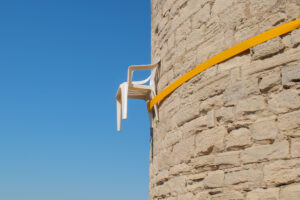
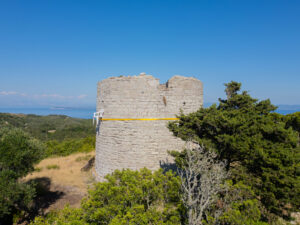
In this work, three seemingly unrelated objects at the westernmost point of Greece, they form a single, irreducible image of something that wants to leave and cannot. The chair faces west and is held from behind by a strap tied around the cylindrical body of the old windmill. What we see is not restraint. Is the visible form of a tension that has no resolution. The desire to leave and the impossibility of leaving, held together in a single action.
Not to touch the earth, Not to see the sun is a visual narrative about a charged space between staying and going, a state that has long defined the identity of Othonoi island.
Dionisis Christofilogiannis
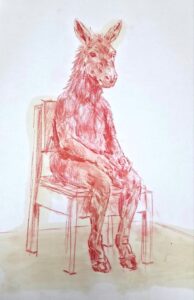
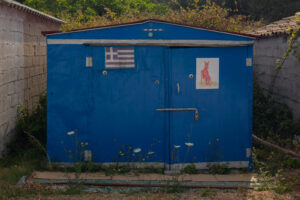
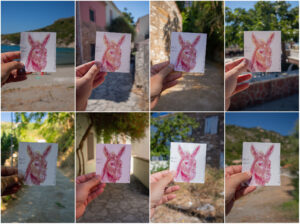
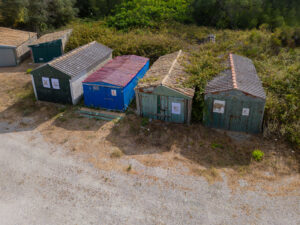 Mimi was the last donkey on the island of Othonoi. She belonged to an elderly woman, yet in many ways she belonged to the entire community. The islanders cared for her and regarded her as part of their shared life. She died in 2025, marking the end of more than the life of a single animal. She never wore a saddle; she wandered freely across the island and was often seen swimming in the sea.
This series is not a portrait of Mimi, but an allegorical body through which the memory of the island is carried. Throughout the drawings she continuously transforms—carrying houses, boats, birds, and cats, becoming a sea creature, or walking along Othonoi’s stone paths.
Mimi becomes a symbol of endurance, care, and the solidarity of a small island community. Home, loss, and collective memory run through the series, turning her into a poetic portrait of Othonoi—a place that continues to exist through what its people choose to love, remember, and care for.
The Krank
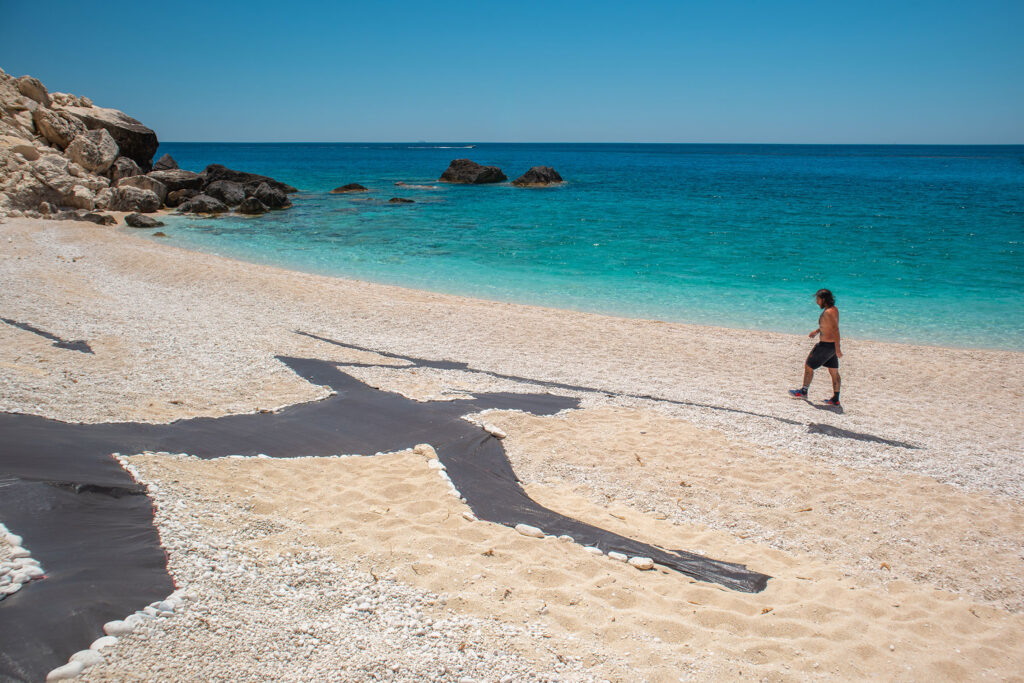
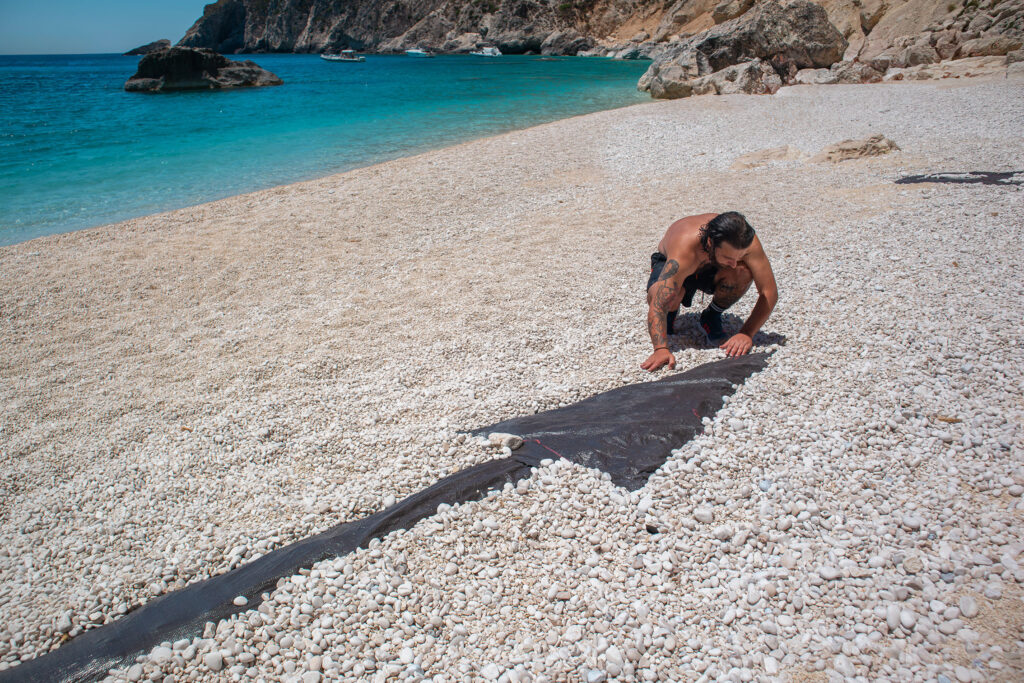
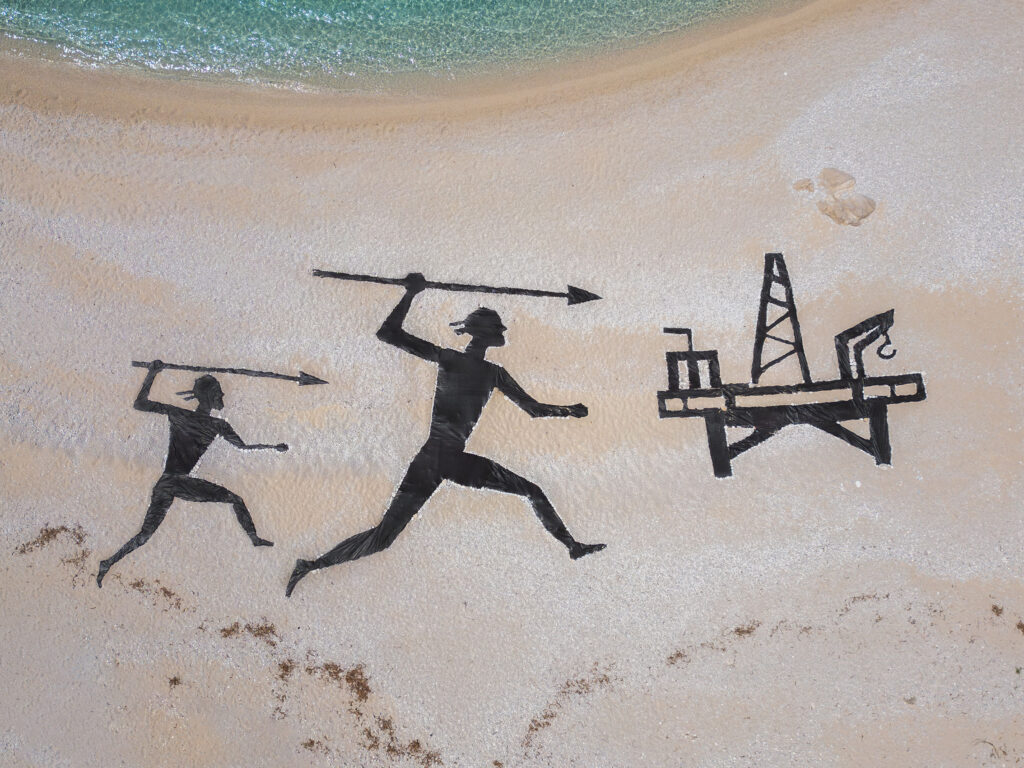
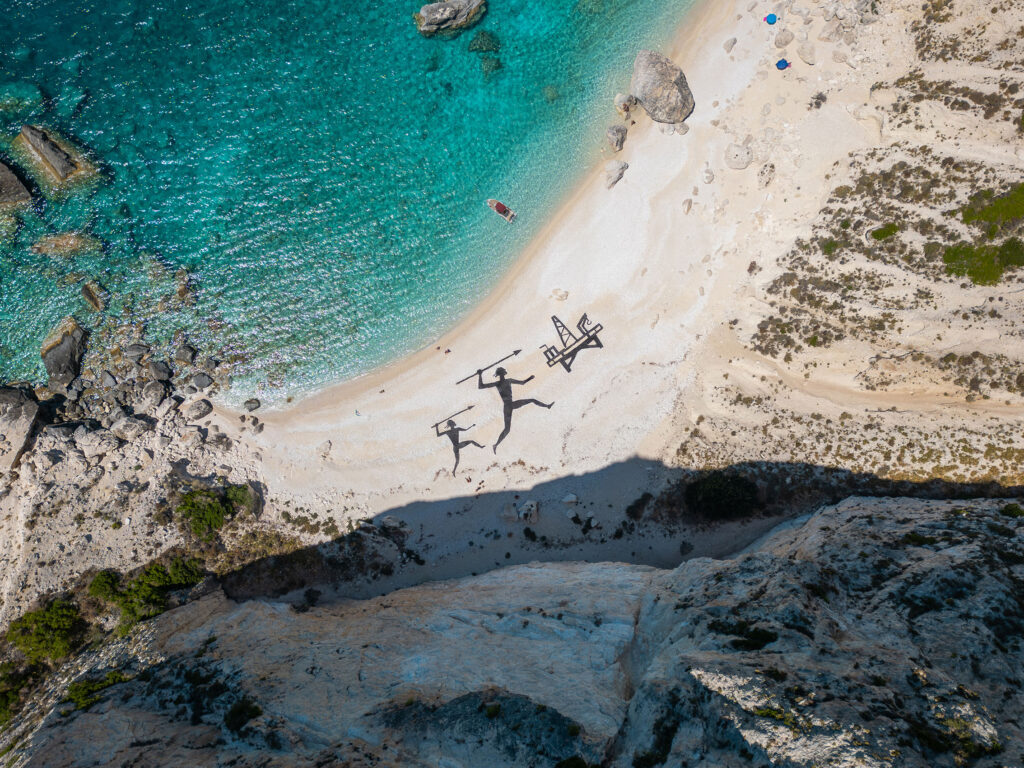
The Hunt, 500m2, temporary land art installation black geotextile, Othoni island 2026, Greece
Titled The Hunt, the large-scale installation is located approximately 10 kilometres from the proposed extraction area and becomes part of the very landscape that is facing an imminent transformation. The work brings together two moments in time, separated by thousands of years. The prehistoric hunter and the contemporary extraction industry appear as different manifestations of the same human impulse: the desire to search, conquer, and extract resources from the environment.
Humanity is portrayed not only as the hunter, but also as the opponent of a new hunter it has created itself. The machine no longer functions merely as a tool, but as a force that reshapes the environment and threatens the conditions of human existence. The figures emerge as archaeological traces, appearing as the last witnesses of a landscape on the verge of becoming an industrial zone. They seem trapped within a mythological moment of conflict between human instinct and technological power.
Vasiliki Koukou
Ogygia is not merely a setting in the Homeric narrative. It is an environment where memory becomes embodied in matter, and where geology, vegetation, and the sea function as carriers of cultural continuity. The association between Othonoi and the island of Calypso sustains this idea, shifting the myth from the realm of history to that of ecology.
In the ancient Greek worldview, nymphs were not supernatural beings detached from nature, but manifestations of the landscape itself. They inhabited springs, caves, trees, and coastal environments, expressing a perception of nature as a living presence endowed with memory and agency. Their form was never fixed, but existed in a continual state of transformation.
Bodies made of water. The body is not defined by its boundaries, but is shaped through its constant interaction with the sea, the atmosphere, plants, microorganisms, and the cycles of life. Water becomes a medium of kinship and memory, carrying matter, time, and history across organisms and ecosystems.
The flora of Othonoi reflects this continuity. The mastic tree, myrtle, wild olive, caper bush, sea lily, and Posidonia oceanica form an interconnected network that extends from the coastal slopes to the seabed.
Posidonia oceanica, one of the oldest living organisms in the Mediterranean, creates ecosystems that sustain biodiversity while preserving the ecological memory of the place. In this context, plants cease to function as a passive backdrop and instead emerge as active architects of the landscape.
The Nymphs arise from this ecological and mythological continuum. As hybrid figures, they embody vegetal growth, marine fluidity, and mythological persistence within a unified morphological language. Their presence invites a different reading of the landscape, one in which form reveals relationships that already exist, between land and sea, biodiversity and memory, mythology and ecology.
Ogygia therefore emerges as a living ecosystem, where mythology is not the memory of a distant past but an ongoing process of becoming. The nymphs do not return. They never left.
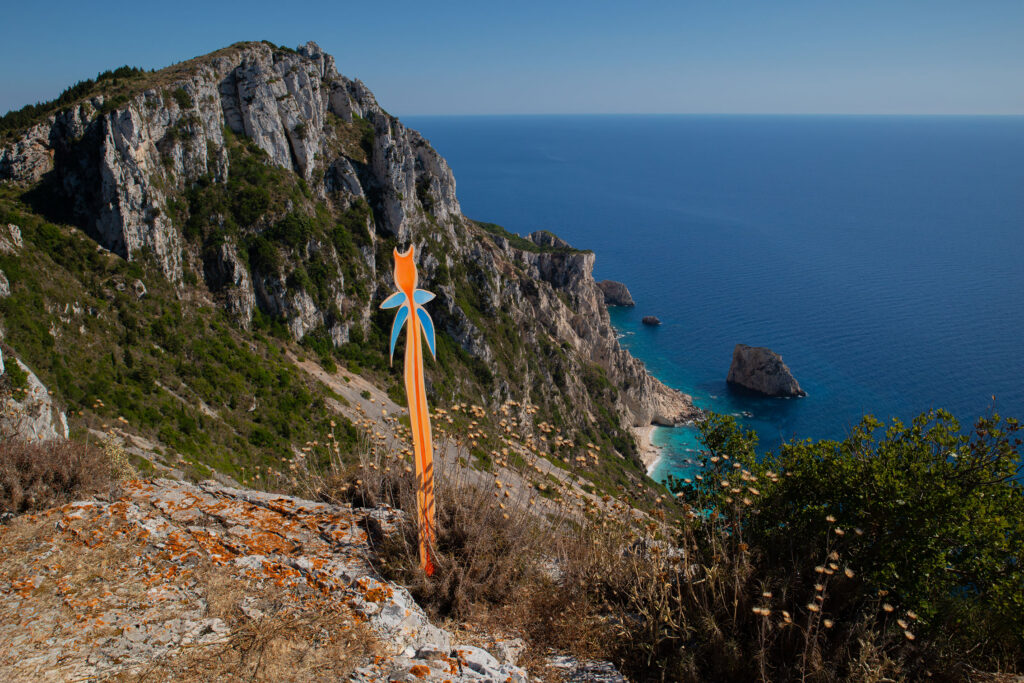
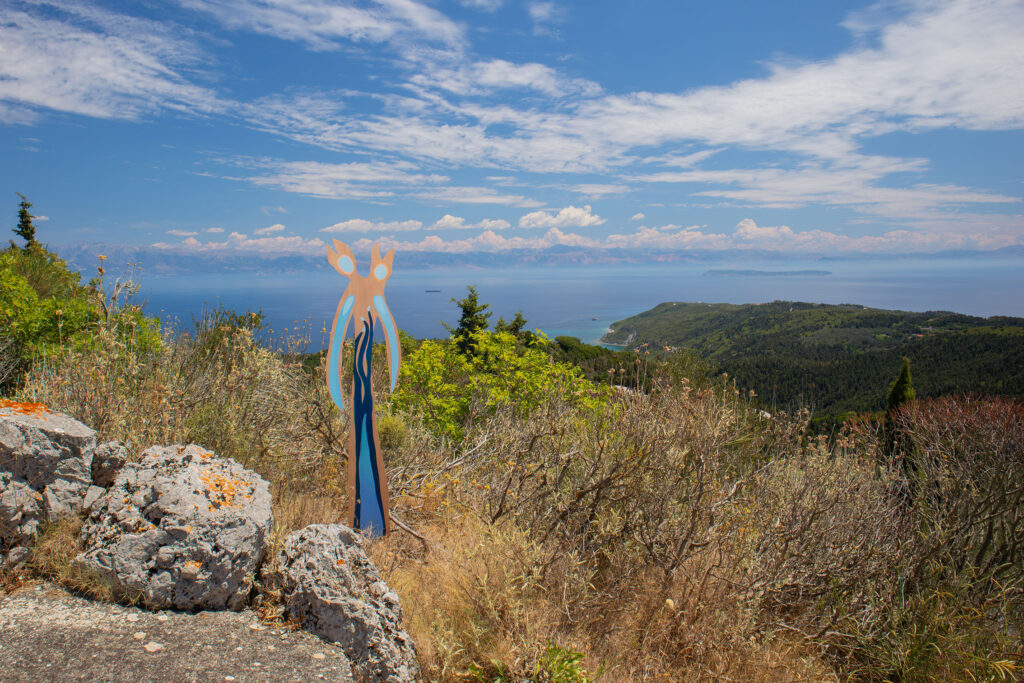
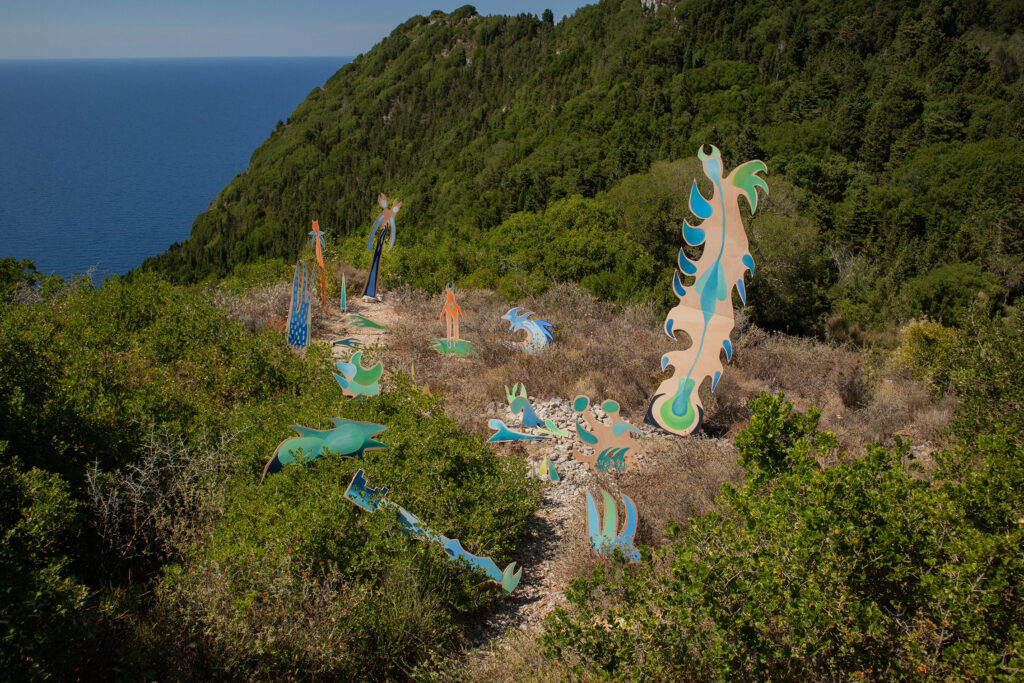
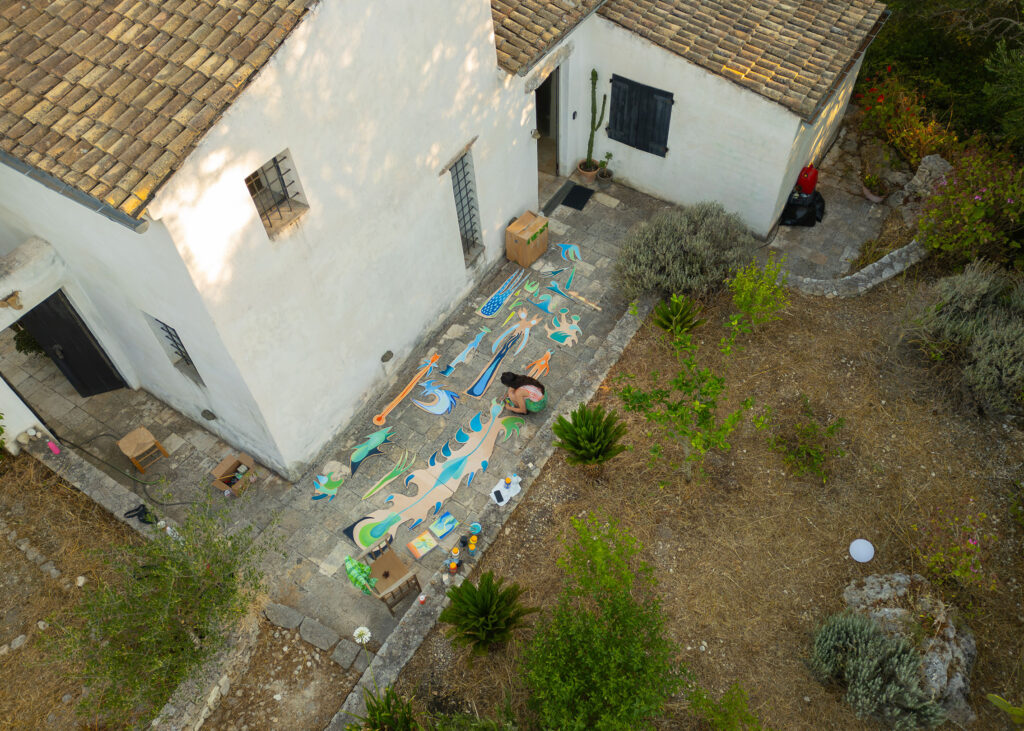
Nymphs of Ogygia, What remains of a myth when people disappear? Perhaps only water.
INFO
Organization – Production: https://www.kalogerou.gr/ @kalogerou1844 https://www.space52.gr/ @space52 Vasiliki Koukou (@vassilikik) Dimitris Kontodimos (@dim_kontodimos) Dionisis Christofilogiannis (@dionisis_christofilogiannis_) The Krank (@the.krank)
Visual Communication: @bold.athens
