Listening to the Earth
(Efi Gousi in Conversation with Dionisis Christofilogiannis, Presented by Space52)
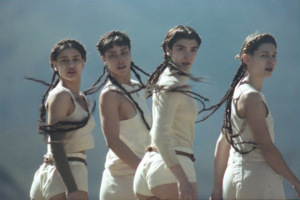
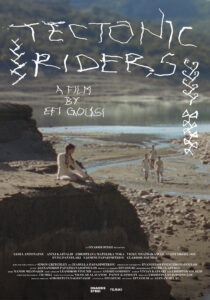
 Efi Gousi’s video installation Tectonic Riders, presented as part of the Plásmata 3 exhibition in Pedion tou Areos, is a poetic and visually striking work that blends myth, ritual, and ecological consciousness. With a duration of 5 minutes and 43 seconds, the film depicts a group of young girls reenacting the ancient ritual of taurokathapsia (bull-leaping), softly whispering to the Earth: “We are here and we hear you.”
Directed by Gousi, in collaboration with screenwriter Alexandra K* and cinematographer Evangelos Polychronopoulos, the work creates an atmosphere that bridges past and present—posing powerful questions about our relationship to nature, memory, and time. The imagery is charged with symbolic weight, offering viewers a meditative space for reflection.
The original score by Manos Milonakis amplifies the emotional impact of the piece, adding depth and tension to its already evocative visuals. Tectonic Riders addresses climate change not merely as an environmental crisis, but as a rupture in our fundamental bond with the Earth and history itself—urging audiences to reconsider their place in the world and the potential for renewal through art and tradition.
The Plásmata 3 exhibition transforms Pedion tou Areos into a liminal landscape where reality and imagination converge. Featuring more than 25 works that combine digital and physical forms, the exhibition invites the public on a nocturnal journey filled with surprises and moments of discovery. As Artistic Director Afroditi Panagiotakou describes it, Plásmata 3 is “a small celebration and a hymn to art and the power of simple coexistence.”
Ultimately, Tectonic Riders stands out as a significant work that merges art with social and environmental awareness, offering a profound experience that encourages introspection, emotional resonance, and ecological empathy.
 Dionisis Christofilogiannis: Tectonic Riders bridges ancient ritual with contemporary ecological and cultural concerns. How did the idea for the project first come to you? Was there a specific image or moment that sparked its creation?
Efi Gousi: I’ve always been drawn to Ηorse Vaulting, a sport that blends acrobatics and movement on horseback, and in many ways feels like a modern descendant of the ancient Minoan bull-leaping rituals. My interest began when I started reading about Τaurokathapsia in ancient Crete, said to be a ritual dedicated to Poseidon, god of the sea and earthquakes. One theory suggested that these ceremonies were performed in his honor to prevent devastating earthquakes on the island.
That idea opened a window, a way to give voice to what had been quietly weighing on my mind. After living abroad for the past few years, putting distance between myself and Greece, I realized how deeply I wanted to return and express what I had been carrying.
The script for Tectonic Riders became a kind of puzzle, a small diary stitched from thoughts and concerns I couldn’t ignore: the climate crisis, the rise of violence in schools, the stories of femicides I kept hearing. And then this question struck me like a lightning bolt:
DC: What ground will we be buried in, if this very Earth keeps bringing the dead back to the surface?
EG: As if our souls can no longer find rest anywhere.
I wanted to bring light to femininity, to female strength, and to believe in the present moment, in togetherness. I didn’t want to stay in the darkness or the destruction we’ve handed down to younger generations. I wanted to ask: what do we do with all this? How do we keep going?
 DC: The work is profoundly poetic – in its rhythm, its visual language, and the voices of the girls. How did you approach the interplay between text, movement, and silence in your direction? What role does the body play in your cinematic language?
EG: I wanted the film to have the feeling of a documentary, like a world you observe from a distance; you listen to its sounds, you watch its movements. That’s where the feminine resides.
The body had to carry the story, the destruction, and a sense of urgency. In the film, it becomes a means of communication with the Earth.
Throughout the piece, you hear nothing but their breathing, until the music enters, like a trigger, unlocking all the emotions and their voices. Then you hear a whispered conversation between two sisters, in a quiet room. They could be two of the girls we see on screen, or they could be the Earth itself, speaking.
DC: The bull appears as a charged and layered symbol. What does the figure of the bull represent for you in this piece – is it myth, memory, power, or something more personal?
EG: If there’s something truly beautiful about art, it’s that the same work can hold different meanings for different people. The bull is all the things you mention myth, memory, power and I wouldn’t want to define it too strictly. What matters most to me is what each viewer reads into it and what they take with them.
In the story of the film, the bull was the last one that remained with the girls. He was their companion during all the rehearsals, right up until the “big day”, when they find him dead. We don’t know what happened to him. That’s why the questions remain open at the end.
But what’s important is that the girls don’t stay in mourning. They focus on what needs to be done for change to come. So they improvise. They find a motorcycle.
 DC: Tectonic Riders is presented as part of a public installation at Pedion tou Areos. How does the open, urban setting affect the way your work is experienced? Do you see value in removing art from traditional gallery spaces?
EG: What this particular exhibition achieves and what I believe is its greatest strength, is that it gives access to people who might not normally visit a museum or a gallery. And if the work manages to give them something to think about at home, if it sparks a question, even by chance, if a single image or phrase stays with them then for me, that’s the real joy and success of this exhibition.
Also, considering the specific location of the video installation, there’s a beautiful dialogue happening with nature, with the trees, the birdsong, all the elements that are lost within the world of the film itself.
__________
“Tectonic Riders”
Year Created: 2025
Country: Greece
Medium: Art Film – Video Installation
Duration: 5.43″
https://www.onassis.org/art/works/tectonic-riders
Director: Efi Gousi
Script: Efi Gousi – Alexandra K*
DoP: Evangelos Polychronopoulos
Cast: Lydia Antonatou, Anixi Kartalis, Christiana Matelska Toka, Vicky Mnatsakanian, Eleni Nikodemou, Evini Pantelaki, Yasmine Papadimitriou, Clarisse Saunier
Commissioned by Onassis Stegi for the Plásmata 3 exhibition
https://www.onassis.org/el/whats-on/plasmata-3