
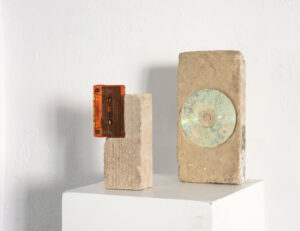
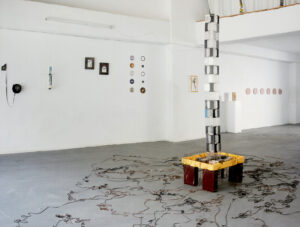
 On the 8th of February, Margot Kalach completed her residency program at space52 with an experimental process using Stones, Bones, and Obsolete Technology.
Margot maintains an experimental and process-based relationship with her projects. The experiment, the game, and the accident are the basis of the historical review of science and technology that the artist makes to understand our sociocultural present. On a large scale, the projects seek to return subjectivity to the center of the scientific models and mechanical systems that govern our current times. Margot emphasizes intimate technologies, the organic evolution of matter, and the philosophy and speculation of science as tools for creation. Currently, she is developing a photographic language without a camera based on a homemade machine with enough imprecision to manage, through a mechanical principle, to go against the predictable behavior and the central control that predominates the current technoscientific world. Formally, Margot commonly resorts to the language of geometry and abstraction from an interest to encompass forms, patterns, and archetypes that are repeated and extend throughout different fields of knowledge.
 It is difficult to move through Athens without noticing the mounds of materials that have been forgotten or discarded. Differently from other cities, where abandoned terrains get quickly restored or residues are sold or reused in a matter of seconds, there is something special about the passing of time in Athens, the tempo of the city, that allows for these ambiguous and forgotten materials to exist for longer time spans in the sight of the everyday traveler.
In my short time here I have been, as it comes naturally to me, collecting a series of objects found in recycling bins and abandoned terrains. You never know what rabbit hole you will fall into, until you display the objects in space and observe, in retrospect, what you have been obsessing with: stones, bones, and obsolete technology.
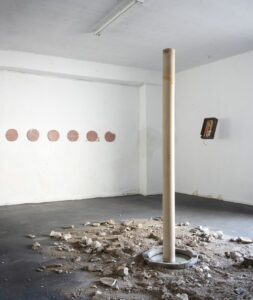
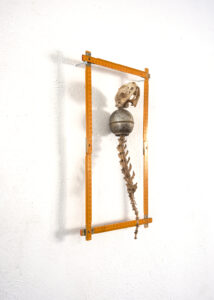 There is an archeological excavation right across the street from where I´m living. Someone threw out their collection of more than fifty cassette tapes in the trashcan next to the house. There are hundreds of large metal basins all around the city where old bricks, unable to support structures anymore, are discarded (I intercepted some before they were thrown into the ocean). Unfortunately, life ends, there are dead cats on the train tracks. I had forgotten floppy disks existed until I found some unwanted next to hundreds of pages of undecipherable information.
There is so much information, now faded, once input in these found containers: stones that contained humans, bones that contained life, or devices that contained memories. Now empty due to their particular obsolescence, yet still with the power of containing meaning when re-assembled. In these short exercises, I attempt to breathe a new life into old skeletons, to reanimate matter, as a way of recycling and creating structures that critically reflect upon ideas of the Anthropocene, of cultural containers as essential to civilization and development, and of looking for answers in forgotten places.
____
 Margot Kalach (Mexico City, 1992) graduated from Bard College with a degree in photography (2016). She attended the SOMA Mexico academic program (2017-2019). She was a recipient of the FONCA Young Creators scholarship (2019) and was a resident at Casa Wabi (2021). Margot has two individual exhibitions: 08J3C71V17Y (Bard NY, 2016) and El Sueño de la Piedra (Ex Convento Tepoztlán MX 2021). She has participated in several collective exhibitions in Mexico, Patricia Conde Gallery (2020), Casa Wabi Foundation (2021), Sinaloa Art Museum (2017), among others. And has shown work in different fairs such as Feria del Millón (Bogotá, Col. 2018) and FAIN (CDMX, 2020). She is co-founder of CROMA (MX), a hybrid space occupied by artist studios and dedicated to contemporary art exhibitions.
—
Margot Kalach

